Why AI Search Visibility Is More Important These Days

Key Takeaways
- AI Overviews now appear in roughly a quarter of all Google searches, changing how people find information online.
- Brands cited inside AI Overviews earn significantly more organic clicks than brands that aren’t mentioned at all.
- Gartner projects that a quarter of organic search traffic will shift to AI chatbots and voice assistants by the end of 2026.
- Traditional SEO alone is no longer enough — businesses now need Answer Engine Optimization (AEO) and Generative Engine Optimization (GEO) to stay visible.
- Working with an experienced digital marketing company in India can help businesses adapt their content strategy for both search engines and AI platforms.
Introduction
Search behaviour is changing faster than most businesses realize. People no longer just type a query into Google and scroll through ten blue links. They ask ChatGPT, Gemini, Perplexity, or Claude a question and expect a direct, well-formed answer. Even inside Google, AI Overviews now sit above traditional search results, summarizing information before a user ever clicks a website link.
This shift means visibility isn’t just about ranking on page one anymore. It’s about being the source an AI system chooses to quote, cite, or summarize. If your brand isn’t showing up inside these AI-generated answers, you’re becoming invisible to a growing share of your audience — even if your website still ranks well in classic search.
In this article, we’ll break down why AI search visibility matters right now, what the data shows, and practical steps businesses can take to stay discoverable across both traditional and AI-powered search platforms.
What Is AI Search Visibility?
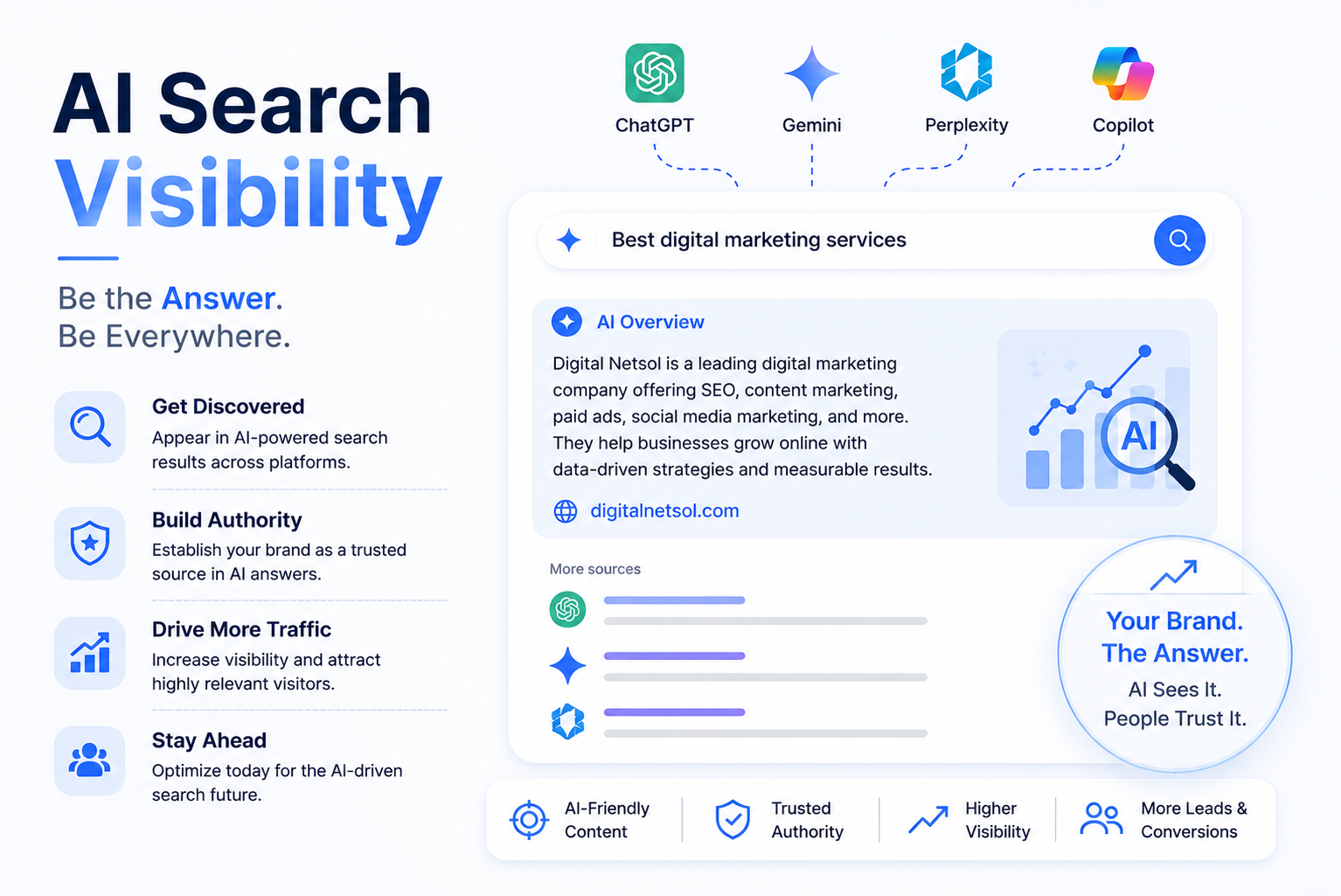
AI search visibility refers to how often and how accurately a brand, product, or piece of content appears in AI-generated answers — whether that’s a Google AI Overview, a ChatGPT response, or a Perplexity summary. Unlike traditional rankings, AI visibility depends on how clearly structured, factual, and citation-worthy your content is, since AI systems pull information to construct their own answers rather than simply linking to a page.
The Data: How Big Is This Shift?
The numbers make it clear this isn’t a passing trend.
- AI Overviews are now mainstream. Semrush tracked AI Overview prevalence climbing from roughly 6.5% of searches in early 2025 to a peak near 24.6% by mid-year, settling around 15.7% by November 2025 — and other trackers put US prevalence as high as 25.8% by January 2026 as Semrush documented AI Overview prevalence climbing from about 6.49% in January to a peak of roughly 24.61% in July before settling at nearly 15.69% by November, with AI Overviews expanding to 25.8% of US searches by January 2026. SQ MagazineStackmatix
- Citations translate into clicks. Brands cited in AI Overviews earn approximately 120% more organic clicks per impression than uncited brands on the same queries, per Seer Interactive’s 2026 analysis. In other words, being mentioned inside an AI answer isn’t a loss of traffic — it can be a major traffic advantage. SQ Magazine
- User adoption is already mainstream. 58% of surveyed users reported performing at least one Google search in March 2025 that generated an AI Overview, per a Pew Research Center analysis published in July 2025. Memeburn
- The shift will keep accelerating. According to Gartner projections, by the end of 2026, 25% of organic search traffic will shift to AI chatbots and voice assistants — a structural change affecting every industry. Stackmatix
Together, these numbers show a search landscape where being “findable” by AI systems is becoming just as important as ranking well in classic search results.
Rather than replacing SEO, AEO and GEO build upon it. The strongest digital strategies combine all three approaches.
Why Businesses Can't Ignore This Anymore
1. Zero-Click Searches Are Rising
Many searches now end without a single click, as users get their answer directly from the AI summary. If your content isn’t the source behind that answer, you lose the chance to be seen at all — regardless of how well-written your page is.
2. AI Platforms Are Becoming Discovery Engines
ChatGPT, Gemini, Claude, and Perplexity are increasingly used the way search engines once were — for research, recommendations, and comparisons. If your business isn’t structured to be understood and cited by these tools, competitors who are optimized correctly will capture that attention instead.
3. Trust and Authority Signals Matter More
AI systems tend to favor content that’s well-organized, factually accurate, and backed by credible sources. This mirrors Google’s own E-E-A-T guidelines (Experience, Expertise, Authoritativeness, Trustworthiness), meaning strong SEO fundamentals and strong AI visibility now go hand in hand.
4. Industry Impact Varies
Not every business is affected equally. Informational content — how-to guides, comparisons, and explainer articles — sees the highest exposure to AI Overviews, while transactional and navigational searches are affected less. Businesses relying heavily on educational content marketing need to pay especially close attention to this shift.
How to Improve AI Search Visibility
- Structure content clearly. Use descriptive headings, bullet points, and concise definitions so AI systems can easily parse and summarize your content.
- Answer questions directly. Lead with a clear, one-sentence answer before expanding into detail — this format is exactly what AI Overviews and chatbots prefer to extract.
- Build topical authority. Publish consistent, well-researched content around your core services so AI systems recognize your site as a reliable source.
- Use original data and insights. Original statistics, case studies, or expert commentary are harder for AI systems to find elsewhere, increasing your chances of being cited.
- Optimize for multiple platforms. Don’t just optimize for Google — structure content so it performs well across ChatGPT, Gemini, Perplexity, and Claude too.
- Strengthen brand search demand. Businesses with strong branded search volume are more insulated from AI-driven traffic loss, since users searching your brand name directly still land on your site.
Partnering with a skilled digital marketing company in India can help streamline this process, combining traditional SEO with modern AEO and GEO strategies tailored to your industry.
SEO vs. AEO vs. GEO: Quick Comparison
|
Approach
|
Focus
|
Goal
|
|---|---|---|
|
Search Engine Optimization (SEO)
|
Traditional search rankings
|
Rank higher on Google's organic results
|
|
Answer Engine Optimization (AEO)
|
Direct question-answering
|
Get featured in voice search and AI Overviews
|
|
Generative Engine Optimization (GEO)
|
Generative AI platforms
|
Get cited by ChatGPT, Gemini, Perplexity, Claude
|
Conclusion
AI search visibility isn’t a future trend — it’s already reshaping how people discover businesses online. With AI Overviews influencing a growing share of Google searches and platforms like ChatGPT and Gemini becoming everyday research tools, businesses that fail to adapt risk losing visibility even if their traditional SEO is strong. The good news is that the fundamentals — clear structure, accurate information, and authoritative content — still matter, just with a new layer of strategy on top.
If you’re ready to make sure your brand shows up wherever your audience is searching, now is the time to act.
Digital Netsol, one of the leading digital marketing companies in Bangalore helps businesses build AI-ready content strategies that perform across Google Search, AI Overviews, and generative platforms like ChatGPT, Gemini, and Perplexity. From technical SEO audits to AEO and GEO-focused content creation, our team ensures your brand stays visible in this new era of search. Get in touch with Digital Netsol today to future-proof your online visibility.
IMPORTANT FREQUENTY ASKED QUESTIONS
What does AI search visibility mean?
AI search visibility means how often your brand or content appears within AI-generated answers, such as Google AI Overviews or ChatGPT responses. It reflects whether AI systems recognize your content as accurate and citation-worthy. Unlike traditional rankings, it depends heavily on clear structure and factual reliability. For example, a well-formatted FAQ section is more likely to be pulled into an AI answer.
Why are AI Overviews important for businesses?
AI Overviews are important because they now appear in a large share of Google searches and often sit above traditional results. Businesses cited within these summaries tend to see stronger click-through rates than those left out entirely. This makes AI Overview visibility a real growth opportunity, not just a threat to traffic. Ignoring it means losing visibility to competitors who adapt first.
Is traditional SEO still relevant with AI search growing?
Yes, traditional SEO is still relevant and forms the foundation for AI visibility. AI systems favor well-structured, authoritative, and trustworthy content — the same qualities Google rewards. SEO and AEO/GEO work together rather than replacing one another. A strong technical SEO base makes it easier for AI systems to understand and cite your content.
What is the difference between SEO, AEO, and GEO?
SEO focuses on ranking in traditional search results, AEO focuses on answering questions directly for voice and AI search, and GEO focuses specifically on being cited by generative AI platforms like ChatGPT or Gemini. All three overlap but require slightly different content strategies. Businesses aiming for full visibility need to address all three.
How can I optimize my content for AI search platforms?
You can optimize content by using clear headings, direct answers, bullet points, and well-supported statistics. AI systems prefer content that’s easy to summarize and factually reliable. Adding FAQ sections and definitions also improves your chances of being cited. Original research or data gives you an added advantage since AI tools can’t recreate it.
Will AI search reduce website traffic?
It can reduce traffic for uncited pages, but citation actually increases clicks for brands mentioned in AI answers. The impact varies by industry and query type, with informational searches affected more than transactional ones. Businesses that adapt their content strategy can offset potential losses. Monitoring citation rates alongside traditional rankings is now essential.
How can a digital marketing agency help with AI search visibility?
A digital marketing agency can audit your content, restructure it for AI readability, and build the authority signals AI systems look for. This includes technical SEO, structured data, and consistent publishing of well-researched content. Agencies experienced in both SEO and GEO can help businesses stay visible across search engines and AI platforms alike.
Author Bio
Anu Sukhija Dhawan
I have over 15 years of experience in SEO and digital marketing. At Digital Netsol, we combine proven SEO expertise with the latest AI Search Optimization (AEO & GEO) strategies to help businesses improve their visibility across Google Search, AI Overviews, ChatGPT, Gemini, Perplexity, and other AI-powered search platforms.